
The difference in purchase price between the ePropulsion Spirit 2 and an equivalent gas-powered outboard motor seems significant at first (because it is!).
However, if you intend to use the motor for the next ten years, the initial cost is just the starting point. Expenses like fuel, winterization, impeller replacements, and routine maintenance accumulate significantly for gas models—costs that are easily overlooked at the time of purchase.
We wanted to illustrate the difference in total overall cost of ownership over time between the ePropulsion Spirit 2 and an equivalent gas-powered outboard motor that competes in the same category. It’s pretty clear that an electric outboard saves you money over time since there’s no fuel to buy—but is that enough to balance out the higher upfront cost?
Below is our analysis, which we’ve kept as scientific as possible, and tried to keep the numbers fair. Let’s dig in.
The Contenders
This head-to-head comparison pits two motors in the same category—portable outboards for small boats, tenders, inflatables, and auxiliary sailing applications. Their power output is truly comparable, providing a practical basis for comparison.
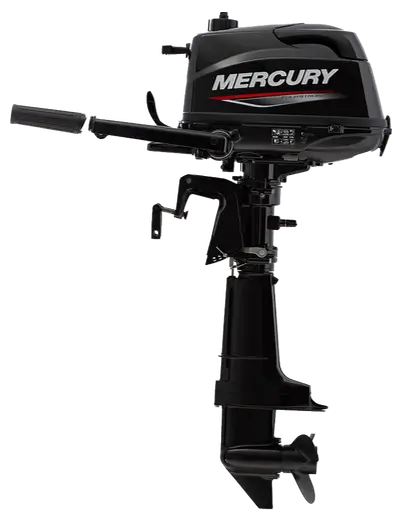
Mercury 5HP
In one corner we have the Mercury 5HP, a 4-stroke, water-cooled gas outboard and arguably one of the most popular small outboards in Canada. The typical shaft length model (long) weighs about 26kgs (58lbs) before adding fuel. Note that with the integrad fuel tank 1.1L of volume), your range will be just over half of what you could expect with the Spirit 2. Therefore, for greater range (which admittedly will far surpass the range of the Spirit 2 without a secondary battery), you should factor in the cost (and extra weight) of an external fuel tank.
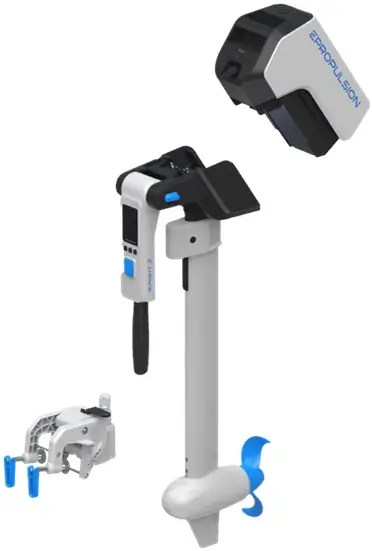
Spirit 2
In the other corner we have the ePropulsion Spirit 2, a 2kW electric outboard with power that’s roughly equivalent to a 5hp gas outboard. It can temporarily boost the power output to 3kW (about 6hp) for short bursts, enough to get a light hull up on a plane. It weighs about 20kg (44lbs), but the detachable battery means you’re able to carry one 10kg (22lbs) piece in each hand (motor + battery). The battery charges from a standard 110V AC outlet, and like all electric outboards, it’s quiet and virtually maintenance-free—no oil, no winterization. Available in extra-short, short and long-shaft variants.
Comparison Factors
Basic Assumptions
- 30 hours of use per year
- Average fuel cost of $1.94 per litre (current national average as of October 2026). Fuel prices may rise over the next few years (probably) or may come down, but for the purposes of this comparison, we’re going to anchor on today’s average price.
- Average electricity cost of $0.17 per kilowatt-hour (kWh). This is the current average price across Canada, although there’s a lot of variability, with Quebec having the lowest price and Alberta and the maritimes having the highest.
Purchase Price
Prices for the Mercury 5HP vary across the country, and season-to-season from about $1,837 to $2,200. The MSRP is $2,190, and the price at a dealer close to us on Vancouver Island is currently $1,965. We chose the average price of $2,000. Keep in mind that due to the weight and box size, shipping will be considerably more than shipping a Spirit 2, so the price you pay is generally the price offered by your local dealer.
The price of the Spirit 2 can be found on the product page here (currently $5,990).
Mercury 5HP
$2,000
Spirit 2
$5,990
Annual Cost Assumptions
The annual costs for a gas outboard include fuel, winterization, miscellaneous repairs.
Fuel
The annual fuel cost for the Mercury 5HP, based burning 45L of fuel during 30 hours of use at mixed throttle use and on the current average gas price, is about $90.
The Spirit 2 requires no gas, so we estimated the electricity cost based on 30 hours of mixed throttle use use (about 33kWh). At the $0.17/kWh, the annual cost would be about $8.
Winterization
Winterizing costs for the Mercury 5HP are estimated about $200 per year on average. They are higher than a smaller air-cooled motor because it has a water-cooled system with more to flush and prepare for storage. If you perform your own winterization, then the cost would be only the materials (4-stroke oil, gear lube, storage seal fogging oil, fuel stabilizer, spark plug), or about $65. But since the vast majority of small outboard owners don’t DIY maintenance, we’re going to use the $200 yearly figure.
By contrast, there’s nothing needed for the Spirit 2 at the end of the season. Just rinse with fresh water if it’s been in salt water and stow it. The battery should be charged to about 80%, then checked periodically as part of good battery maintenance practices.
Miscellaneous Maintenance and Repairs
Other yearly costs for owning a Mercury 5HP include carburetor cleaning (also not yearly but about $40/year on average), fuel line, primer bulb, recoil starter rope, cotter pins and other maintenance that arise from using the a gas motor that lives outside all season. We’re allowing $100/year, which is a conservative estimate.
The Spirit 2, with only one moving part, generally requires no maintenance or repairs—there’s just not much to go wrong.
Propellers need periodic replacement for both motors if and when they get damaged. As such, we consider this a wash on both sides. The same goes for sacrificial anodes—they’ll need replacement, especially if used in saltwater, every 2-3 years. In both cases, the cost is minimal.
Mercury 5HP
Fuel: $90/year
Winterization: $200/year
Other maintenance / repairs: $100/year
Spirit 2
Electricity: $8/year
Winterization: $0/year
Other maintenance / repairs: $0/year
Periodic Cost Assumptions
There are significant periodic costs that should be expected with both motors.
Scheduled servicing to keep the Mercury 5HP in good shape and avoid costly repairs later is needed. We’re assuming a fairly typical $400 every 4 years. THis includes replacing the impeller—the Mercury 5HP is water-cooled, so the impeller needs periodic replacement.
However the most significant periodic expense to expect is for the Spirit 2: replacing the battery. Lithium batteries have a finite lifespan, degrading over time. Luckily the Spirit 2’s battery is user-replaceable—you only need to buy a new battery, not a whole new motor. And batteries are currently expensive, although always coming down in price. We’re going to assume a battery replacement at year 7 and at the current price, which is a conservative estimate. With proper storage the battery may well last longer, and it will undoubtedly be less expensive at that point.
Mercury 5HP
Scheduled servicing: $400 every 4 years
Spirit 2
Battery replacement: $2,295 at year 7
The 12-Year Analysis
The Spirit 2 starts out at 3 times the price of the Mercury 5HP, but does it remain significantly more expensive to own over time?
In short, throughout a 12-year period, the Spirit 2 does remain the more expensive option, but not significantly. Somewhere in the 12th year the total cost of ownership of both motors becomes equal, with the Spirit 2 being the less costly option for a short period of time—until the battery needs to be replaced again.
The Big Takeaways
The Battery is the Most Consequential Variable
If it wasn’t for the replacement cost of the Spirit 2 battery, the break-even point would happen in year 8, and from then on you’d be better off with the Spirit 2. The Spirit 2’s running costs are so low that the gap would continue to widen significantly the longer you kept it.
We set the battery replacement at 7 years, which is conservative. The Spirit 2 battery is rated for 1,000 cycles while still maintaining an 80% charge. At only 30 hours per year with roughly one full charge per use, you’d be charging it only 30 times per year, and at that rate, you’d reach 1,000 charge cycles around year 30, not year 7.
But we know from experience that the age of the battery also has an effect on its performance over time, in addition to how well it’s cared for. A battery stored properly over winter could realistically last 10 or more years. If the battery lasts until year 10, the Spirit 2’s 12-year cost advantage grows significantly.
And of course, as battery technology improves and prices continue to drop, the gap narrows further.
Gas Prices Matter
A meaningful portion of the annual cost of running a gas-powered outboard motor is the price of fuel. If fuel prices continue to rise (as current socio-economic trends suggest they will), the ownership cost gap narrows further.
In addition, this analysis is based on a relatively modest usage of both motors in a season (30 hours). As the usage increases, the yearly cost increases through the burning of additional fuel (as well as more frequent maintenance and service).
There's Still a Premium for Electric
We can’t deny it—it’s more expensive to own an electric outboard in the short term in many (but definitely not all) cases.
However, people aren’t buying electric outboards because they are less expensive. The explosive growth in electric propulsion is not for financial reasons—it’s for the many benefits that these motors offer that electric outboard customers happily state far outweigh the price premium.
What the Financial Analysis Doesn't Tell You
An electric outboard like the ePropulsion Spirit 2 doesn’t make pure financial sense in the short term, as it takes years to overcome the upfront purchase price and battery replacement costs (the only real costs!). The longer you own it, the better the math gets, but why do so many people swear by electric outboards even in the first few years of owning one?
We’ve written about the obvious reasons why you might want an electric outboard, and also the unexpected benefits that you’ll likely encounter as a very pleasant surprise.
For instance, avoiding refueling and everything that comes with it—no jerry can, no spills, no smell on your hands or in your car. Then there’s the convenience: push-button starting every time. No choke, no priming, no yanking you arm out of its socket six times in front of your family. No wondering if the engine is flooded and if it will in fact start today.
For many owners the lack of maintenance more than justifies the price premium. Each year with a gas outboard, you arrange a winterization visit, leave the motor, wait, then collect it. With the Spirit 2, that whole routine vanishes. Rinse it with fresh water after saltwater use, keep the battery at 50–60% charge through winter, and you’re finished. That returns genuine time to your life.
Maybe it’s the elimination of all fumes and polluting discharge into the water, or being able to cruise in virtual silence, with only the sound of water splashing against the hull that makes it worth it. or maybe it’s being able to easily carry the Spirit 2, with it’s two main components weighing only 10kgs (22lbs), and easily tossing them in the back seat of your car.
Whatever benefits you value most, you will likely find that it’s easy to justify the price premium of an electric outboard motor. And if you’re still skeptical, keep in mind that it’s easy to find out if an electric outboard motor is worth it with our try before you buy program.