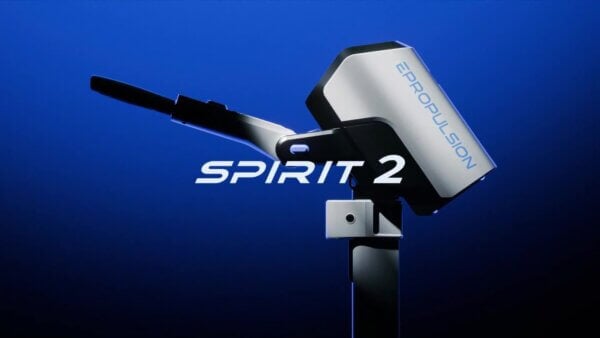
The ePropulsion Spirit 2 is without a doubt the most exciting development (so far) in electric outboards in 2026. It’s the still a perfect combination of lightweight, quiet and clean, and now that it’s twice as powerful as the world’s most popular electric outboard (the Spirit 1.0 Plus), it’s tempting to ask why would anyone buy any similar electric outboard models now that it’s available (well not quite—but we’re taking preorders)?
Is it the now the best option if you want clean, silent, reliable and low-maintenance power for a small boat, tender, dinghy, RIB/SIB, jon boat, or small sailboat?
The Spirit 2 is currently priced at $6,990 (including the battery). Here’s how it compares to it’s closest peers in our catalog:
Spirit 1.0 Plus
At $4,790, the entry-level Spirit 1.0 Plus is $2,200 less. It is 50% as powerful and has a smaller battery, and of course missing the great design improvements of the Spirit 2, but if you have a small tender, value price-performance ratio above all else and don’t need all the bells and whistles, the Spirit 1.0 is still a solid value and easy recommendation.
RemigoOne
In many ways, there’s a solid case for the RemigoOne to still be the best choice for many use cases. With its all-in-one, rugged design, it’s a very different animal altogether. Many people find the lightweight portability (12kg in total), versatility (fits all shaft lengths), and simplicity of operation to be irreplaceable. if you’re using it on a small tender, don’t require hydrogeneration, don’t care about the flexibility of extending the range with an extra battery, we would heartily recommend the RemigoOne.
Spirit 1.0 Evo
The Spirit 1.0 Evo is similar in price to the Spirit 2, but lacking all the goodness in the new Spirit 2 design that we can’t see it being nearly as popular as it was. For the $1,280 price difference between the two, we can’t recommend you purchase the Spirit 1.0 Evo for your sailboat unless your budget simply can’t afford the Spirit 2. The doubling of power, increase in range and brilliant design more than covers the price difference.
Navy 3.0 Evo
The Navy 3.0 Evo is also threatened by the Spirit 2, since the only distinct advantage it has is the ability to run continuously at 3,000W output (6 hp equivalent), whereas the Spirit 2 can only do so for short bursts (60 seconds) with a cool-down period in between. The highest output power that the Spirit 2 can run at continuously is 2,000W (5 hp equivalent). Assuming you combine the Navy 3.0 Evo with the recommended battery (the E60), you’ll have about twice the range in addition to a slightly higher power output. However this combination (including the tiller and battery charger) is $3,438 more expensive than the Spirit 2. We see few situations where a Spirit 2 is a better option than a Navy 3.0 Evo.
Conclusion
In short, the Spirit 2 sits in a sweet spot that simply didn’t exist before. It delivers dramatically more power and range than the Spirit 1.0 Plus, closes the gap with the Navy 3.0 Evo at a much lower price, and makes the Spirit 1.0 Evo a tough sell for most buyers. The RemigoOne remains a compelling specialist choice for ultra-light, ultra-simple portability—but if you want the best all-around balance of power, innovation, flexibility, and long-term value in a modern electric outboard, the Spirit 2 is now the benchmark in its class.